FUNDRAISER WANTED

The Fundraiser will assist the Fund Promoter to make contacts with high profile Investors. This is a unique opportunity that besides a ROI above the market rate does guarantee a MARKETING RETURN improving the Investors’ Image acting as a DEVELOPMENT’S ACTORS.

The FUND should have no more than five Founders who initially subscribe $ one million to start operations in selected African Countries from where there are already funding requests amounting at $ half million from Tanzania, Kenya, Côte d’Ivoire, Ghana, Nigeria and Benin; besides, requests are from Morocco and Tunisia.

Two trips to the Continent have been planned for round-up meetings with existing high-level contacts.


INVESTMENT PROPOSAL – Fundraising

Taking from our banking background, we will go straight to point. We would like to present a Project already shared in some conversations and here we take the opportunity to say thank you and congratulate the commentators, whose feedback encouraged this step.

This Investment-Proposal is well rooted in our field activity, particularly when we designed, managed and evaluated Credit Guarantee Fund/ Trust Fund/ Grant Facility/ Revolving Fund in Tunisia, Bosnia, Caribbean (St. Lucia), Romania, Mali, Albania, Netherlands Antilles (Curacao), Malawi, Algeria, Morocco, Ghana and Russia Federation.

The importance of business financing doesn’t need to be reiterated: Bankers/Investors did it for centuries. The proposed JAMBO FUND deal with financing the underserved customers, focusing on the small and medium enterprises, which are the backbone of the countries’ economies. https://ascaniograziosi.net/2017/02/14/jambo-twofold-objective/

JAMBO TWOFOLD OBJECTIVE is to provide financial resources to UNDERSERVED ENTREPRENEURS and assistance to UNDERCAPITALISED LENDERS to achieve common objectives and interest,  both of them being undercapitalised.

However, JAMBO isn’t just financing but much more: it is a new way to approach the market. In particular, we elaborated on both the Basel III Committee Document on Financial Inclusion and the Goal 8 of UN 2030 Agenda: “Promote inclusive and sustainable growth”. It is worthwhile to note that in the wave of digitalization, the proposed approach is of utmost importance because the basic question isn’t to provide people with a smart Mobile phone or WhatsApp but to have people eligible for its use. Under the particular circumstances, the methodology will guide the interventions in the emerging economies with a well-defined algorithm and appropriate market segmentation, as it has been visualised in the Slide – letters c and d -, which explains the methodology behind the Project.

Incidentally, although the FUND specifically refers to the Continent, the Paradigm is viable and valid for the emerging economies and country level as well. In this understanding, if there is a specific request, it can be fitted into the Model.

There are questions we have already provided with an answer like Why a Fund? Why Africa? Which assumptions? Which justifications? Where to start? How much capital to invest? Which is my position? https://www.linkedin.com/post/edit/6275982994779971584

JAMBO aims at being A GATEWAY TO AFRICA’s INCLUSIVE GROWTH, opportunities being available in each one and every country. https://ascaniograziosi.net/2017/06/01/jambo-fund-the-gateway-to-africas-inclusive-growth/

The forty pages of the Project-Document starts from the review of the narrative of Africa’s achievements, from which we detected FUND’s assumptions and justifications along with conclusions highlighting the great opportunities by sustaining the entrepreneurship and in so doing have a positive impact on the communities. 

Summing up ….:

The FUND’s features have been shared with a Group of Professionals https://www.linkedin.com/groups/4682884 and received hundreds of appreciations.

– The Business Model has been designed and confirmed by our field activity.

– Although the FUND’ horizon is the Continent, initially, the focus will be in Nigeria, Ghana, Kenya, Morocco, Tunisia, Cameroon, Tanzania and Algeria, to be confirmed by the Investors.

– The administrative and operational components will be presented as options to validate along with the proposed links with national finance providers, lending & credit policy.

– The Investors Committee will select the Fund Manager along with the place to register the business, – in Africa – where le Office shall be located (soft structure).

– The operations may be advanced by a field survey in the above-selected Countries, but it may be replaced by our contacts in the Continents: we shall have field trips for round-up meetings with the purpose to come back with a significant portfolio.

– The SME/SMI’s market niche has been growing and currently has been estimated at $ 1.5 billion (South-Saharan Regions).

–  The initial investment for grounding the activities should be above US $ half million.

– Besides the ROI, the Investors can benefit from a non-negligible marketing/image return by acting as a development’s actor: https://ascaniograziosi.net/2017/06/01/jambo-fund-the-gateway-to-africas-inclusive-growth/.

– At this stage, we are available to provide truly interested Private Investors, Entities, Funding Agencies, Donors, Finance Providers, Banks with additional information they need.

In this perspective, we look forward to reading from you: graziosiascanio@aol.com .

SEVEN QUESTIONS ABOUT JAMBO FUND

The line announcing JAMBO (Swahili salutationgot hundreds of clicks and here I congratulate those who kindly showed interest and commented on. Below, the key questions.

1-   Recently, you launched JAMBO FUND FOR AFRICA: Which is the scenario?

I designed the FUND taking inspiration from the Documents/Papers released by the international financial establishment and, among others, Basel III Committee, CGAP, UN 2030 Agenda on SDGs. With particular reference to Africa, I found it very attractive Mr. Elumelu’s  Africapitalism, a Nigerian tycoon and banker, who, in 2014, in an interview spelled out his vision on what to do to promote African entrepreneurial spirit and how to approach microfinance issues; among other, he said: “It’s all about sustainability”.

I elaborated on above background information and I designed JAMBO borrowing from my extensive field experience; in particular, I designed, managed and evaluated Credit Guarantee Fund/ Trust Fund/ Grant Facility/ Revolving Fund in the following Countries: Tunisia, Bosnia, Caribbean (St. Lucia), Romania, Mali, Albania, Netherlands Antilles (Curacao), Malawi, Algeria, Morocco, Ghana and Russia Federation. In other words, experience and expertise have been a necessary background to drawing it, which afterwards will be a requirement to run the business, which asks for accumulated daily exposure to evaluate the credit risks.

2 – Presenting JAMBO, you said that the Fund is an innovative approach, why?

JAMBO isn’t business as usual and indeed isn’t just financing but much more: it is a new way to approach the market. As a matter of statement, I elaborated on the message articulated by the financial establishment, at least how I detected it. This the best way to innovate: to introduce something new in a mechanism already in use.The reasoning behind the below Figure has synthesised the idea that justifies why and how to sustain the entrepreneurship, which had hundreds of clicks and tens appreciations. Bankers/Financiers did business over centuries and the importance of financing doesn’t need to be explained. However, under the particular circumstances, the Figure illustrates how to make interventions in favour of entrepreneurship in the emerging economy and in so doing make a tangible impact on the communities. In particular, I elaborated on the Goal 8 of UN 2030 Agenda: “Promote inclusive and sustainable growth”. In the wave of digitalization, the proposed approach is of utmost importance because the question isn’t to provide people with a smart mobile phone or WhatsApp but to have people eligible for its use.

3 – You said that the finance providers should work as a driving belt; could you explain it?

I do have my own idea, of course, but the issue should be discussed together with the Investors in connection with the parallel objective of the FUND: assisting microfinance sector, which is important not only for the single entity but for the sound achievement of the financial inclusion. The interest of the micro financial providers to cooperate is well beyond the availability of fresh resources, because JAMBO will provide them with advice to review and revise the style of management, to better meet the underserved customers’ needs.

4 – How to start operations?

JAMBO’s horizon is the Continent, opportunities being available in each one and every Country, but initially, the focus will be on some Countries to be agreed with the Investors: Nigeria, Ghana, Kenya, Morocco, Tunisia, Cameroon, Tanzania and Algeria (to be agreed). The operations may be advanced by a field survey although it isn’t necessary and indeed it may be overcome with my contacts in the Continents: I do have in mind to achieve field trips for round-up meetings with the purpose to come back with a significant portfolio.  For the time being, the FUND’s model has to be completed and I have prepared a Project-Document of some forty pages. However, the exercise has to be finalised in agreement with the Investors, who should say a word on topics that belong to them: Institutional and Administrative Arrangements, Organization Structure, Decision Making process, Policy & Procedures. On the matter, I have elaborated some slides for discussion.

5 – Where JAMBO shall be located?

The office shall be located in Africa to campaign the FUND at inception and then to be close to the Borrowers. The FUND shall have a soft structure with a FUND Manager, a national consultant and a secretary. I have worked out a tentative timetable for establishing the Fund: a month time could be the period to complete the job, depending on the way the Investors will speed up the process.

6 – Which would be your role?

I am a Consultant and in my advisory position, I proposed a Model of intervention because I do believe it is a valid and viable intervention. It will be up to the Private Investors/Institutions/Funding Agencies to appoint a Fund Manager and the other Executives Positions in the Board. Having conceived and designed the Model and being a field man I will be available to act as a Partner and be involved in running the business, of course.

7 – Why the Investors should subscribe? 

The Project-Document starts with the narrative of Africa’s economic development and from this exercise, I drew operational conclusions; justifications and assumptions have been listed in ad hoc paragraph. The investment shall have economic return and a social impact on the communities as well; also, the investors shall appreciate the return on the image, being the development’s actors for providing opportunities and reduce jobless. It is worthwhile to note that the market has been estimated at $ 1.5 billion and JAMBO has been designed to take these opportunities.

WHY 98% OF START-UPS ARE REJECTED?

Recently, the start-up topics have been the media headlines, which intrigued us and we decided to look into the matter and try to provide an answer to the very low rate (2%) of successful fundraising, which the article’s author explains with six sins.

Above all, we do think that there has been much emphasis and enthusiasm on start-up as a way to launch businesses, which has been inflated by the media; we don’t say that start-up is like a scoop, we do say that it has been overstated before evidence.

The “sins” listed in the article should be called and actually are missing points made by the fundraisers. On top of everything, there is a basic question: HOW TO SWITCH AN IDEA INTO A PROJECT: the former although being a good one isn’t a venture, the latter should comply with the feasibility criteria along with justifications and assumptions.

By and large, inventors aren’t necessarily entrepreneurs: they have different ways of working and other backgrounds as well. Working on an idea that has been well elaborated in a laboratory with a complete formula isn’t like running it as a business and to make it happens deserves an entrepreneurial spirit.

In the above understanding, we tried to match what the author said with what we did in presenting the Project JAMBO FUND.

Going through the article’s recommendations to avoid failures, we can say that the presentation of JAMBO FUND, since the very first announcement, avoided the “six sins” and the “Seven questions about JAMBO FUND ”, are a further justification in support of the Project (https://www.linkedin.com/post/edit/6275982994779971584): the Post spelled out the reasoning behind and why the Investors should endorse it (see also: https://ascaniograziosi.net/blog, which give account of the research we did).

We investigated on the international context and reviewed the narrative of Africa’s development trend; then, we completed the exercise with findings and conclusions, which drove to the design of JAMBO FUND AS A GATEWAY TO AFRICA’s INCLUSIVE GROWTH: vision, mission, assumptions, justifications, objectives, target. In addition to, we provided the Project with both a Model: https://www.linkedin.com/feed/update/urn:li:activity:6256035102674026496/ and indicated our career as a field man with expertise on the funds matters.

In our line of business – financing projects – which is the relevant missing point? Taking from our field experience, we witnessed situations where projects failed because of the shortage of the necessary working capital or its size wasn’t appropriate for the business inception’s length. When the lenders financed such projects without investigating on the working capital, they lost the money lent out: the borrowers became defaulters. Combien de fois nous avons réitéré le message sur l’importance du Fond de Roulement, à l’époque des missions dans l’Afrique Sub-Saharien ?

Fundraising is a serious matter and currently, even training courses are proposed on the subject: converting people’s failures into an opportunity!

JAMBO FUND: The Gateway to Africa’s inclusive growth

Post on 01/06/2017 https://www.linkedin.com/post/edit/6275982994779971584
The line announcing JAMBO (Swahili salutation) got hundreds of clicks and here I congratulate those who kindly showed interest and commented on. Below, the key questions.

Africa has made the headlines, again, as a Continent of opportunities, since President Obama’s announcement $ 2.5 billion Programme Power Africa Initiative, while visiting the Continent in 2013.
We found out it very attractive Africapitalism, Mr.Elumelu – Nigerian tycoon and banker – idea (2014) on how to promote African entrepreneurial spirit: “There are some areas — flood disasters, for instance — where you must give charity. But I think the charity approach to solving other issues must be reassessed. It’s all about sustainability; it’s all about self-reliance”.

The demographic trend is the basic data to look at, to catch the economic development’s challenges. According to UN, Africa’s population has been exploding and the unemployment rate among youngsters is alarming; the Continent shall see its current population of 1.2 billion double by the year 2050. That’s an expected growth of 42 million people every year”. The importance and the implications of above data don’t need to be emphasised.

The FUND will provide financial resources to Underserved Customers, as per Basel III financial inclusion’s definition, namely, the small and medium business that are the backbone of the countries’ economy. It will do it by assisting (parallel objective) MFI/Finance Providers to achieving a performing position in the market, in the projection that the sector will face challenges in the following three big areas: UNDERCAPITALIZATION, DIGITALISATION and MANAGEMENT.

We have finished the job and are ready for comments, inquiries and feedback from truly interested Firms, Private Investors, Institutions, Donors, Funding Agencies, Organisations, etc. and provide them with the Project-Document: graziosiascanio@aol.com

THE REASONING BEHIND “JAMBO” FUND FOR AFRICA

Above all, we would like to congratulate the 2,300 “clickers”, much more if we count those “outside LinkedIn” and in particular those who commented on https://www.linkedin.com/feed/update/urn:li:activity:6255675757557874688/

JAMBO FUND FOR AFRICA isn’t business as usual and indeed isn’t just financing but much more. It is a new way to approach the market. As a matter of statement, we elaborated on the message from the international financial establishment, at least how we detected it. This the best way to innovate: to introduce something new in a mechanism already in use.

The reasoning behind the display has synthesised the idea that justifies why and how to sustain the entrepreneurship. Bankers/Financiers did it over centuries and the importance of financing business doesn’t need to be explained.

However, under the particular circumstances, the Exhibit (not yet the final one) show up how to make interventions in favour of entrepreneurship in the emerging economy and in so doing make a tangible impact on the communities. We went through three basic documents: the UN 2030 AGENDA for SDGs, in particular, the Goal 8: “Promote inclusive and sustainable growth” (www.un.org.) along with BASEL III Committee ( http://www.bis.org ) and CGAP http://www.cgap.org/publications/new-funder-guidelines-market-systems-approach-financial-inclusion.

In our understanding, there has been a repositioning by the international financial establishment on development finance issues, because in the past the importance of the term sustainability hasn’t been emphasised as a key factor that should inform all development finance interventions. Over decades the development interventions focused on credit, sometimes easy going to credit at the grassroots level, on the assumption that everybody has the right to get it; but this isn’t true because credit means confidence and it is sanctioned when the applicant is eligible for it and it is a lender discretion. This doesn’t mean that the financial leverage to the business isn’t important; on the contrary, it is vital, on condition to use it according to the eligibility criteria. This hasn’t been all time applied and the abuse and misuse of credit have caused the financial implosions we witnessed in many countries.

This can be achieved with a credit model and following an appropriate market segmentation, as it has been widely discussed in the iBook FINANCIAL INCLUSION, Give people a job, not a loan, https://itunes.apple.com/us/book/id1116912686, which contents are the reasoning behind of the proposed ground activities.

In the wave of digitalization, the proposed approach is of utmost importance because the question isn’t to provide people with a smart mobile phone or WhatsApp, but to have people eligible for its use. There are two ways to understand digitalization: product innovation and process innovation. The former when we simply provide the client with an electronic device, the latter when the electronic device adds value to the service and creates opportunities, because without economic inclusion there will be no real inclusive inclusion.
In this context, we have proposed a new approach moving from CREDIT-BASED ECONOMY to COMMUNITY-BASED ECONOMY. thus re-designing the entire architecture of the intervention in favour of poor people and small business as well, and shift the theoretical paradigm of the financial system from over indebted economy at micro and macro level to a real people’s empowerment via jobs creation and promote opportunities.
We don’t say to restore the Keynesian theory, we do say that the role of finance in the economy has been dominant at macro and micro level, to detriment of the real economy, on the wrong assumption that poverty is a lender task instead of a government duty.

Moving from above reasoning we have designed a RISK FUND FOR AFRICA as a business way to empower viable enterprises at both Start-up and Grow-up stage, on the grounds that there is a market worth $ 1.5 billion and JAMBO FUND has been designed to take these opportunities. Who does what and how? https://ascaniograziosi.net/2017/02/28/jambo-fund-who-does-what-and-how/

We said “elaborated” on above documents that inspired our work. But we did it borrowing from our extensive field experience dated over three decades in twenty-eight Countries and in the following ones we designed, managed and evaluated Credit Guarantee Fund/ Trust Fund/ Grant Facility/ Revolving Fund: Tunisia, Bosnia, Caribbean (St. Lucia), Romania, Mali, Albania, Netherlands Antilles (Curacao), Malawi, Algeria, Morocco, Ghana and Russia Federation. In other words, experience and expertise are a necessary background to run these kind of business, which ask for accumulated daily exposure to evaluate credit and financial risks.

JAMBO will be proposed soon as a FINANCE START-UP. Fundraising Managers are invited to join the campaign. Investors, Funding Agencies, Corporate Finance and Venture Capitalists may contact us for additional information: https://ascaniograziosi.net

WHY “JAMBO” IS THE MARKET SOLUTION

JAMBO FUND FOR AFRICA isn’t business as usual, besides being a financing solution, on the grounds of the following:

First, it has been inspired by the UN 2030 Agenda for Sustainable Development Goals: JAMBO VISION.

Second, it will focus on sustainable interventions to promote countries’ inclusive growth: JAMBO OVERALL GOAL.

Third, it has been designed referring to the guidelines provided by Basel III Committee on financial inclusion, via market segmentation: Unserved people and Underserved customers: JAMBO OBJECTIVE.

Four, the interventions will target Underserved Customers segment, to support viable projects at Start-up and Growth-up stage: JAMBO SPECIFIC OBJECTIVE

Five, Financial intermediaries will work as driving belt between the Fund and SME/SMI: JAMBO STRATEGY.

Six, it will follow the holistic approach and suitable management criteria within a well-defined Model of intervention ( https://itunes.apple.com/us/book/id1116912686)
rationalising inclusive growth: JAMBO METHODOLOGY.

Seven, it will finance and provide advice MFI to support SME/SMI to achieve a performing position in the market, both actors facing the same three big challenges: Undercapitalisation, (inadequate capital), Digitalization (new products), Management (style of): JAMBO TWOFOLD OBJECTIVE.

Although JAMBO’s horizon is the Continent, market opportunities being available in each and every country, initially the attention will be on: Botswana, Morocco, Egypt, South Africa, Zambia, Cote d’Ivoire, Algeria, Tanzania, Namibia, Burkina Faso (to be updated after Fundraising closure).

Summing up, JAMBO’s idea comes from to the above documents, but we designed it borrowing from our extensive field experience and in particular on the following Countries where we designed, managed and evaluated Credit Guarantee Fund/ Trust Fund/ Grant Facility/ Revolving Fund: Tunisia, Bosnia, Caribbean (St. Lucia), Romania, Mali, Albania, Netherlands Antilles (Curacao), Malawi, Algeria, Morocco, Ghana and Russia Federation. In other words, experience and expertise have been the necessary background to drawing, which afterward will be a requirement to run these kind of business, which ask for accumulated daily exposure to evaluate the credit risks.

JAMBO has been be proposed as a FINANCE START-UP. Let’s assume that each one and every two thousand clickers of the preliminary presentation https://www.linkedin.com/feed/update/urn:li:activity:6255675757557874688/ will subscribe “JAMBO” FUNDRAISING CAMPAIGN with €/$ 500, the amount available will easily get €/$ one million that is the minimum amount required at inception phase. Fundraising Managers are invited to join the campaign and African Investors along with Venture Capitalists from anywhere are welcomed.

NEW AVENUES FOR DEVELOPMENT FINANCE (How to take $ 1.5 billion market opportunities)

To our knowledge “JAMBO” is the first RISK FUND designed within the UN 2030 Agenda for SDGs along with the guidelines of Basel III Committee on financial inclusion. Here we would like to explain the reasoning behind its construction.
The line https://www.linkedin.com/feed/update/urn:li:activity:6255675757557874688/ presenting “JAMBO” FUND FOR AFRICA has been clicked hundred times and got tens appreciations. We have to say that the proposed approach goes well above and beyond the purpose as a tool for financing ground activities; indeed the Figure has been elaborated from the methodology rationalizing the model to inclusive growth and for a comprehensive understanding you may go through: https://itunes.apple.com/us/book/id1116912686.
In particular, we utilized the market segmentation as a means to group people belonging to four big segments: a) People in need of basic services, b) People who aim at improving family budget, c) People who aim at start-up business, d) People who aim at growth-up business.

In the first segment, we are in the presence of food aid intervention while in the second one we have income generating activities; in the third and fourth segment the service provider is in presence of enterprise development. We may say that the points a), b) and c), d) refer, respectively, to Unserved and Underserved customers, taking from Basel III Committee’s terminology, which mention customers and not people, meaning that a link with a finance provider is a pre-condition for whatsoever intervention. Under the circumstances, the terminology Unserved people indicate that poverty matters should be addressed with economic policy instruments; accordingly, the terminology underline the difference among lender, developer and philanthropist: this is what we have detected, at least.

In this understanding the achievement of SDGs become a function of the actors’ capability and skill to deal with financial and economic inclusion, which have to be conjugated together, to have the desirable impact; indeed, financial inclusion alone could be a disillusion for the provider, an illusion for the client and a likely financial implosion within the community.

Back to the proposed FUND, we have elaborated on above documents and in particular, endeavoring the meaning of Goal 8 “Promote sustainable inclusive economic growth”, which should inform all development finance interventions: this is a real revolution made by the international financial establishment and it is quite incomprehensible that industry’s insiders haven’t emphasized the concept as it deserved. Prior to the release of above-said documents, the concept of sustainability has been almost neglected and, what’s more, there has been a misapplication of the use of the micro credit, privileging the outreach either horizontal (reach an increasing number of people) or vertical (cheap services) and in so doing ignoring the eligibility criteria.
Taking from the institutional narrative dealing with financial inclusion, the main message we perceived has been to move from CREDIT-BASED ECONOMY to COMMUNITY-BASED ECONOMY, thus re-designing the entire architecture of the approach in favor of poor people and small business as well, and shift the conceptual paradigm of the financial system from over indebted economy at micro and macro level to a real people’s empowerment via jobs creation.

We don’t say that there should be a restoration of the Keynesian theory, we do say that the role of finance in the economy has been dominant at macro and micro level, to detriment of the real economy, on the wrong assumption that poverty is a lender task instead of a government duty.

We simply elaborated from the suggestions and guidelines issued by the international financial establishment (WB, CGAP, etc.) and designed a RISK FUND FOR AFRICA as a business way to empower viable enterprises at both Start-up and Growth-up stage,  on the grounds that there is a market worth $ 1.5 billion and JAMBO FUND has been designed to take these opportunities.
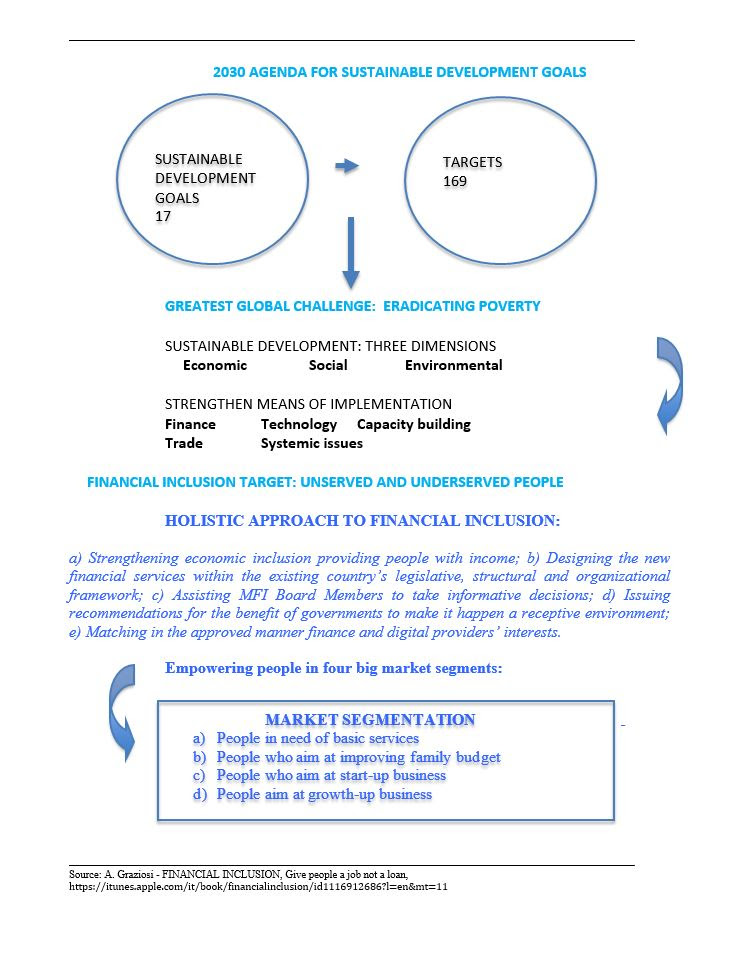
Who does what and how? https://ascaniograziosi.net/2017/02/28/jambo-fund-who-does-what-and-how/


Africapitalism, Creating Shared Value, Community-Based Economy

1. In 2013 the US President Barak Obama visiting Africa announced a US $ 2.5 billion Programme Power Africa Initiative, which renewed the interest for the Continent.
A year later, Mr.Elumelu – a Nigerian tycoon and banker – in an interview (2014) spelled out his vision on what to do and promote African entrepreneurial spirit: “There are some areas — flood disasters, for instance — where you must give charity. But I think the charity approach to solving other issues must be reassessed”. It’s catalytic philanthropy”. For more: https://www.devex.com/news/tony-elumelu-s-new-africapitalism-82590.
In 2011 M. Porter and M. Kramer have proposed the concept of Creating Shared Value – CSV (already anticipated: Harvard Business School) and have criticized capitalism as a major cause of social, environmental, and economic problems: http://hbr.org/2011/01/the-big-idea-https://www.bing.com/creating-shared-value/

We have found interesting parallelisms between Africapitalism and Creating Shared Value, the former focusing on sustainability factor, the latter criticizing capitalism: “Companies are widely thought to be prospering at the expense of their communities
Moreover, M. Harper assessed Grameen Bank (Bangladesh) and Self Help Group systems and, among other things, concluded, “there is little direct evidence as to whether SHG or Grameen system is more effective at reaching the poorest people”; currently this statement can be sustained with more facts and figures.

We are in support to above approaches and since 2011 have proposed a demarcation line among food aid, income generating activities and enterprise development (A. Graziosi Suggestions for designing new credit models, Microfinance Gateway, 06/2011 – Rated among the first five most read documents in 2011), in view of designing a sustainable credit model, http://www.microfinancegateway.org/p/site/m/template.rc/1.9.51017/; recently we have dealt with the topic “Methodological approach and ground work for achieving SDGs https://www.linkedin.com/pulse/methodological-approach-ground-work-achieving-sggs-ascanio-graziosi?trk=hp-feed-article-title-publish.

2. We have elaborated on the recent documents released by the international financial establishment (WB, CGAP and UN Agenda for SDGs) and concluded that financial inclusion without economic inclusion could be a disillusion for the lender, an illusion for the client and a likely financial implosion for the community, which is well synthetized in the sub-title of the iBook “FINANCIAL INCLUSION, Give people a job not a loan”, thus re-designing the entire architecture of the approach in favor of poor people and small business as well, https://itunes.apple.com/us/book/id1116912686.

Although any MFI is social oriented the degree of achieving a social mission could be quite different whether the MFI is in the segment of Enterprise Development (ED, accumulation), Income Generating Activities (IGA, increase family income) or Food Aid-Security (FAS, distribution of basic food to very poor people). The ED segment, being capable to finance small business, can create durable jobs and mitigate the poverty; the IGA segment, while addressing the households’ budget, can help families with basic needs and start small business. The FAS segment comprises people in absolutely poverty and in need for water, food aid, food security, anti-Aids or charity: this is neither micro credit nor microfinance, but micro grant and should be de-linked from credit matters.

We don’t say that there should be a restoration of the Keynesian theory, we do say that the role of finance in the economy has been dominant at macro and micro level to detriment of the real economy, on the wrong assumption that poverty is a lender task instead of a government duty.

As we have extensively discussed in our iBook, the main message we detected from above sources is to move from CREDIT-BASED ECONOMY to COMMUNITY-BASED ECONOMY.

The financial leverage to business is important and even vital, of course, and its sustainable use creates jobs and opportunities, government providing an enable environment and related services. With a salary people may or may not apply for a loan and buy a smart mobile phone; in so doing the meaning of credit – confidence – will be reinstated; regards to the digitalization of the financial services the real question isn’t to provide people with a WhatsApp, but to have them eligible for its use.

The operational implications of above are of great importance and we will deal with the matter.

RESTRUCTURING MICRO FINANCIAL SECTOR: THE NEXT FRONTIER

Nowadays microfinance sector has been undergoing important changes. There is a challenge the micro finance providers shall have to face in the near future: ECONOMY OF SCALE. Those who are familiar with the field activities should be aware that the unit cost for many small size MFI could be unbearable; under the circumstances the business size can make it the difference. Talking to micro financiers they do think that outreach services either horizontal (new outlets) or vertical (new products) is the solution. In our direct experience we didn’t recommend the former way because before expanding they should put in order the house (balayer la maison, d’abord, je me souviens d’avoir dit dans une mission au Maroc), the latter is currently practiced via digitalisation of the services. In our perception of the market, the digitalisation has the same effect of the aspirin: it temporarily alleviates the illness but isn’t a therapy.
Usually, the management problems can be sorted out by keeping low the in-house unit cost and there are many ways to do it, but this matter deserves an ad-hoc discussion, because it calls in cause the review and revision of the decision-making process and could be unpopular among Board Members.

There is an ongoing trend started in 2010 when the Central banks made the first step on a supervisory and monitoring role of microfinance sector, after the release of the Basel III document on microfinance activities. The document inspired central banks in the emerging economies to make order in an uncontrolled market. Our followers may recall that we commented on above source and then published A. Graziosi – Suggestions for designing new credit models, Microfinance Gateway, 06/2011 – Rated among the first five most read documents in 2011). As a matter of fact in the past the micro finance market has been “no-man land”: http://www.emergingmarketsesg.net/esg/2016/08/26/five-questions-about-financial-inclusion-special-interview-with-dr-ascanio-graziosi-rome-italy-august-26-2016/ Some commentators argued that microfinance sector has nothing to do with Basel III Committee!

A second step started beginning 2016  with the release of Basel III Committee document on financial inclusion  ( http://www.bis.org, ). For a complete picture and understand the current and future trend of the micro financial market it could be useful going through CGAP (http://www.cgap.org/publications/new-funder-guidelines-market-systems-approach-financial-inclusion), Banana Skins(http://www.aboutmicrofinance.com/wp-content/uploads/2016/07/Banana+Skins_07-16_v8.pdf ) along with the Financial Sector Development for Africa (http://www.fsdafrica.org/ ). We did it and published FINANCIAL INCLUSION, Give people a job not a loan, https://itunes.apple.com/it/book/financialinclusion/id1116912686?l=en&mt=11 .

A third step may be predicted in the near future and most likely shall be the restructuration of the sector: the time being function of the speed of the ongoing transformation of MFI into Micro Banks. At that time the central banks might release the guidelines on how to MFI should position in the market.

Economy of scale is in an unpopular issue because will make unhappy people (not a few) sitting in the MFI board room.

The good news is that the sector doesn’t need to invent anything because everything has already been experienced by the banking systems some decades ago. What did they? They invested in culture, innovation and outsourcing advisory services.  MFI can to do it? How much is the MFI’s budget for advisory services? We know the answer. Whatsoever the case, there shall be a shrinking of the market on the ground that, as we have commented previously, some three out of four MFI aren’t performing.

The MFI alone can do very little, that’s to say nothing. The representative associations should take the lead. To our knowledge, in the ongoing financial inclusion process they have been spectators of the trend and we don’t think that they shall do something important in the future. See also: Three big challenges: https://ascaniograziosi.net/2017/01/23/thre-big-challenges-for-microfinance-market-in-africa-undercapitalisation-digitalisation-and-management/